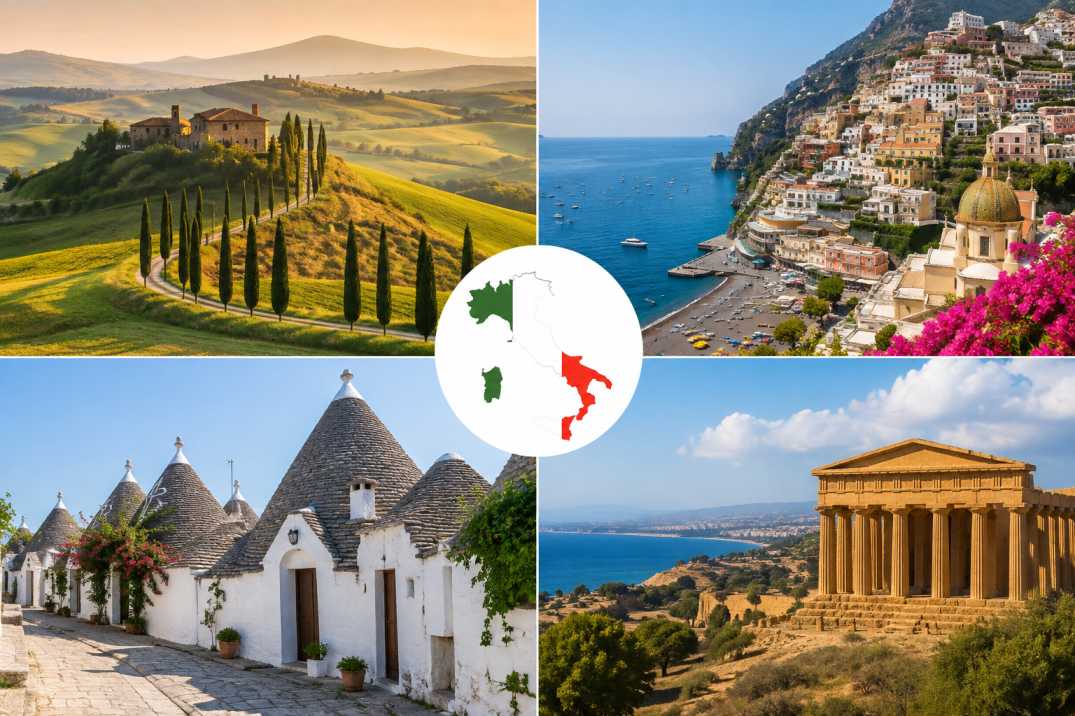
If you have only one week in Italy, choosing where to go can be harder than planning the itinerary itself. Tuscany, the Amalfi Coast, Puglia, and Sicily all offer excellent food, beautiful towns, history, and scenery—but they create very different kinds of holidays.
The most useful rule is simple: choose one region and experience it properly rather than trying to collect several places in seven days. With flights, airport transfers, check-ins, packing, and departure logistics, your seven-night trip may give you only five genuinely usable sightseeing days.
So don't ask which destination is “best.” Ask which one gives you the kind of week you actually want.
Tuscany vs. Amalfi Coast vs. Puglia vs. Sicily
| Region | Best for | Getting around | Typical pace | Main trade-off |
| Tuscany | Art, wine, countryside | Trains + car | Relaxed to moderate | Not primarily a beach trip |
| Amalfi Coast | Coastal scenery, couples, boat trips | Ferries, buses, transfers | Moderate | Expensive, steep and busy |
| Puglia | Beaches, food, villages, road trips | Car is useful | Slow | Fewer major art museums |
| Sicily | Archaeology, food, volcanoes, variety | Car + trains | Moderate to active | The island is too large to cover fully |
The quick answer: Choose Tuscany if you want Renaissance art, wine and countryside. Choose the Amalfi Coast if dramatic sea views and coastal living matter most. Pick Puglia for beaches, food and a slower road trip. Choose Sicily if you want ancient sites, volcanoes and the widest cultural mix.
The Seven-Day Reality: Why One Region Makes More Sense
A common mistake is treating a seven-day holiday as seven full days of sightseeing. It isn't.
Your arrival day may disappear into flights and transfers, while your final day is shaped by check-out and getting to the airport. Add a hotel change or two and you can easily lose another half-day simply moving luggage.
That is why geography matters more than the number of attractions on your wish list.
Think in clusters, not countries. Florence and the Tuscan countryside work together. The Amalfi Coast can be explored from one well-positioned base. Puglia's Valle d'Itria and Adriatic coast form a manageable cluster. In Sicily, eastern Sicily alone can fill a week.
Trying to combine Tuscany with Amalfi, or Sicily with Puglia, usually turns your holiday into a transport exercise.
Tuscany: Choose Art, Wine and Countryside
Tuscany makes sense when you want a classic combination of culture and rural Italy. Florence gives you major art and historic sights, while areas such as Chianti and Val d'Orcia shift the experience toward vineyards, hill towns and long lunches.
Flight gateway: For the easiest seven-day itinerary, look at flights into Florence (FLR) first; Pisa (PSA) is a useful alternative if the fares or connections work better.
A practical structure is three nights in Florence followed by four nights in the countryside. You can spend the first part walking Florence and visiting its major museums, then rent a car once you leave the city.
How to spend seven days
A practical structure is three nights in Florence followed by four nights in the countryside.
You can spend the first part walking Florence and visiting its major museums, then rent a car once you leave the city. In the countryside, concentrate on one area rather than trying to tick off every famous Tuscan town.
Chianti is particularly suited to this approach: the Chiantigiana road links Florence and Siena through villages including Greve, Castellina and Radda.
Do you need a car?
Not for Florence. A car becomes much more useful once you want wineries, small villages and rural accommodation.
Be careful with historic centres, though. Italy uses ZTLs—restricted traffic zones—in many cities and towns, and entering one without the required permission can result in a fine. Rental companies can also pass driver details to authorities when an automatic camera records an offence.
Pick Tuscany if...
- You love art: Florence gives you a strong cultural base.
- You enjoy wine: Chianti and other wine areas fit naturally into a seven-day trip.
- You want variety: You can combine a walkable city with quiet countryside.
What you give up: Tuscany is not the choice if your ideal holiday means swimming every afternoon and spending most of your time beside the sea. Stay up-to-date with the latest travel news and tourism updates
Amalfi Coast: Choose Scenery, Romance and Coastal Days
The Amalfi Coast is less about ticking off museums and more about how you spend your days: coastal walks, ferries, boat trips, seafood lunches and evenings overlooking the water. It is also the region where logistics can surprise first-time visitors.
Flight gateway: For a seven-day trip, Naples (NAP) is the most practical airport, followed by a transfer to the coast.
A good approach is to choose one base and explore from there rather than changing hotels. Ferries and buses can handle many coastal trips, while driving adds narrow roads, traffic and expensive parking.
How to spend seven days
For a one-week trip, resist the temptation to change hotels repeatedly. Pick a strategic base and use ferries, buses or organised transfers for day trips.
You could spend your week between your base, Amalfi, Ravello, Positano and a boat or island day. The point is to leave some afternoons deliberately empty.
The transport reality
A rental car sounds convenient until you actually have to park it. In Positano, central street parking is extremely limited in summer, while paid car parks close to the pedestrian centre currently list rates of about €8–€10 per hour.
The physical layout matters too. Positano and other coastal towns involve steep streets and stairs, so a hotel that looks close to the centre on a map may involve a substantial uphill walk with luggage.
For most visitors, not driving is an advantage here.
Pick Amalfi if...
- Views are the priority: The coast itself is the main attraction.
- You want romance: Hotels, restaurants and boat trips suit couples particularly well.
- You enjoy coastal travel: You can build the week around ferries, swimming and slow meals.
What you give up: affordability, flat walking and the freedom of a car. Positano is also highly seasonal; local guidance notes that many hotels close between November and March. Read the best travel guides and tips for every destination
Puglia: Choose Beaches, Food and a Slower Pace
Puglia works particularly well when you don't want your holiday to feel like a sightseeing competition.
The core seven-day area is the Valle d'Itria and Adriatic coast, where you can combine Monopoli, Polignano a Mare, Ostuni, Alberobello and Locorotondo without attempting to cover the entire region. Flight gateway: For this itinerary, look at Bari (BRI) first; Brindisi (BDS) is another useful option, particularly for the southern part of Puglia.
Puglia's official tourism material also groups these towns into practical day-trip combinations.
How to spend seven days
Base yourself around Monopoli, Ostuni or the surrounding countryside and build your days around short drives.
One day might mean Alberobello and Locorotondo. Another could be a beach morning followed by dinner in Ostuni. Leave room for a long lunch, an olive-oil tasting or an evening walk rather than filling every hour.
Why a car helps
A car gives you access to countryside accommodation, beaches and small towns that are less convenient by public transport.
Just remember that historic centres can have restricted-access zones, and parking is not always available where you expect it. The same Italian ZTL rules apply here as elsewhere.
Pick Puglia if...
- You want to slow down: It rewards longer meals and fewer hotel changes.
- Food matters: Regional cooking is part of the experience rather than an afterthought.
- You want beaches and towns: You can combine both without crossing a huge island.
What you give up: If your dream Italian week involves major Renaissance museums or large archaeological sites every day, Puglia may feel lighter on sightseeing.
Sicily: Choose History, Volcanoes and Variety
Sicily is the most difficult of these four regions to plan badly because its size encourages overambition.
For one week, do not try to see the whole island. Eastern Sicily alone offers Catania, Taormina, Mount Etna, Syracuse, Noto and several other worthwhile stops; Sicily's official tourism itinerary itself treats eastern Sicily as a substantial route.
Flight gateway: For an eastern Sicily itinerary, Catania (CTA) is the most practical choice; Palermo (PMO) makes more sense if you decide to focus on the west instead.
Focus on eastern Sicily
A sensible seven-day trip could use Catania or the surrounding area as one base, followed by a second base around Syracuse/Ortigia.
That gives you access to a useful mix of archaeological sites, Baroque towns, Etna and coastal scenery without spending every other day crossing the island.
Driving and trains
A car gives you flexibility, particularly once you move beyond the major cities. But don't rent one simply because you are in Sicily; if your itinerary is built around Catania, Taormina and Syracuse, you can structure portions of the trip around public transport and organised excursions.
The biggest mistake is building an itinerary that zigzags between eastern and western Sicily. You will spend hours travelling when those hours could have been spent eating, swimming or exploring.
Pick Sicily if...
- History is your priority: Greek and Roman archaeology is a major part of the experience.
- You want variety: Cities, beaches, Baroque towns, markets and volcanic landscapes can fit into one trip.
- Food is central: Sicily's food culture is distinctive and regionally varied.
What you give up: a completely effortless holiday. Sicily rewards planning, and you need to accept that some travel time is unavoidable. Explore the best travel destinations around the world
Which Region Fits Your Travel Style?
Your travel style can narrow the choice quickly.
| If your priority is... | Look at... |
| Renaissance art | Tuscany |
| Wine and countryside | Tuscany |
| Dramatic sea views | Amalfi Coast |
| Romantic coastal hotels | Amalfi Coast |
| Beaches and relaxed days | Puglia |
| Food-focused road trip | Puglia |
| Greek and Roman archaeology | Sicily |
| Volcanoes and varied landscapes | Sicily |
| Minimal hotel changes | Amalfi or Puglia |
| City + countryside combination | Tuscany |
If you're travelling without a car, don't judge the regions only by whether public transport exists. Ask whether your specific itinerary works without a car. Florence is easy to structure on foot and by train; the Tuscan countryside and rural Puglia are different propositions.
Also Read:- Top 10 Visa-Free Countries for US Passport Holders in 2026
What Changes by Season?
Season can change the decision almost as much as your interests.
Spring: Tuscany is particularly attractive for countryside walks and sightseeing before the hottest months. Puglia and Sicily also work well if you want a mix of towns and outdoor time.
Summer: Coastal destinations become more compelling, but heat, crowds and accommodation prices matter. The Amalfi Coast in particular requires more advance planning, while inland Tuscany can feel very hot.
Autumn: Tuscany becomes appealing for food and wine-focused travel, while Sicily and Puglia can retain warm-weather appeal into the shoulder season.
Winter: Your priorities shift toward cities, food and cultural sightseeing. Coastal resort areas can become much quieter, and some seasonal businesses close; Positano, for example, has many hotels closed during the low season.
The Biggest Mistakes to Avoid
Trying to combine regions. A map can make Italy look deceptively compact. Airport transfers, train connections, rental-car collection and hotel check-ins consume real holiday time.
Driving everywhere. A car is useful in Tuscany and Puglia, but it can be a liability on the Amalfi Coast. Italy's ZTL restrictions also make driving into historic centres something you need to understand before picking up the keys.
Treating Sicily like a small region. Choose east or west for a one-week trip. Don't build an itinerary that requires repeatedly crossing the island.
Overplanning every day. Your best Italian meals and favourite towns are often found in the gaps between scheduled attractions. Leave at least a little room for weather, tired legs and the restaurant you decide to stay in for another hour.
The Simple Decision
You don't need to find the objectively “best” part of Italy. You need to match the destination to the week you want to have.
Choose Tuscany for art, wine and countryside.
Choose the Amalfi Coast for dramatic coastal scenery, romance and boat days.
Choose Puglia for beaches, food, villages and a slower road-trip rhythm.
Choose Sicily for archaeology, volcanoes, markets and cultural variety.
With only seven nights, the smartest move is usually the least complicated one: pick one region, keep your bases geographically tight, and give yourself enough time to actually experience it. The other three aren't going anywhere.
Also Read:- 15 Best Hotels in Prague: Where to Stay by Neighborhood

Comments 0
Only approved comments are shown here.