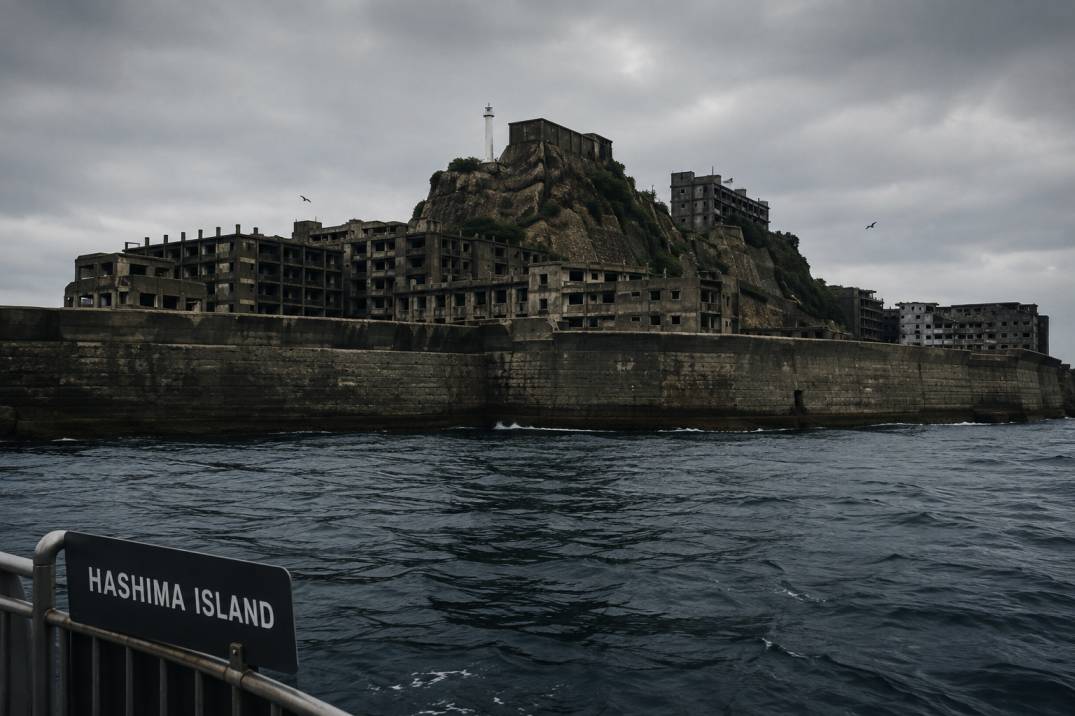
From Nagasaki, Hashima Island first appears as a dark line on the horizon. As your boat gets closer, the shape becomes clearer: layers of concrete buildings packed tightly behind a high seawall, with very little greenery and almost no open space.
This is Hashima, better known as Gunkanjima, or “Battleship Island.” You don't visit it like an ordinary Japanese attraction. There are no cafés to stop at, souvenir shops to browse, or streets where you can wander wherever you like. Instead, you arrive by boat, follow a controlled visitor route and look across a landscape of abandoned apartments, industrial remains and crumbling concrete.
That unusual experience is exactly why Hashima has become one of Japan's best-known dark-tourism destinations.
Hashima Island at a Glance
| What to know | What to expect |
| Location | Offshore from Nagasaki, Japan |
| How you visit | Organised boat tour |
| Boat journey | Roughly 45 minutes each way on some current tours |
| Time on the island | Usually around 45 minutes on a landing tour |
| Access | Restricted to designated visitor areas |
| Main attraction | Abandoned industrial and residential landscape |
| UNESCO status | Part of the Sites of Japan's Meiji Industrial Revolution |
| Biggest uncertainty | Whether sea conditions allow landing |
Exact schedules, prices and operating conditions vary by tour company and date. For example, a current 2026 Hashima Concierge schedule shows departures from Tokiwa Terminal, with the island visit lasting about 45 minutes; its standard adult fare currently starts at ¥5,500. Explore the best travel destinations around the world
What You Actually See on Hashima Island
The first thing to understand is that you don't explore Hashima freely. After landing at Dolphin Pier, you follow designated observation routes with a guide rather than entering the abandoned buildings.
What you can expect to see:
- Reinforced-concrete apartment blocks packed tightly together
- Remains of industrial facilities and seawalls
- Empty exteriors, collapsed sections and weathered structures
- Three designated viewing areas along the visitor route
You may have seen photographs of rooms, staircases and corridors inside Hashima, but these are not areas you can freely access. The deteriorating structures make the island feel less like an open ruin to explore and more like a preserved site viewed from a controlled distance.
That restricted perspective is part of what makes Hashima so striking: you are looking at the remains of an entire community from just a few permitted points, with the sea surrounding you.
What you can expect — and what you can't
| What you might expect | What the visit is actually like |
| Exploring abandoned apartments | Viewing the buildings from designated areas |
| Walking wherever you want | Following a controlled visitor route |
| Entering old mine tunnels | No unrestricted access to underground workings |
| Taking your time alone | Visiting as part of an organised tour |
| Photographing every part of the island | Photography is limited by the permitted route and safety rules |
| A conventional sightseeing attraction | A guided industrial-heritage experience |
If your idea of abandoned places comes from urban-exploration videos, Hashima may feel surprisingly controlled. That is intentional. Stay up-to-date with the latest travel news and tourism updates
Why Tourists Are Drawn to Hashima
Hashima's appeal goes beyond being abandoned. Its extreme density, stark concrete architecture and isolated setting give it a character you won't find at most ruins.
From the water, the tightly packed buildings create the island's famous battleship-like silhouette. Up close, you notice:
- Weathered concrete façades and empty windows
- Seawalls and industrial remains
- Nature slowly reclaiming parts of the site
The surrounding sea adds to the experience. With no neighbouring town or modern buildings in sight, the abandoned settlement feels completely cut off from the outside world.
The Island Is More Than a Collection of Ruins
One mistake is to think of Hashima simply as an abandoned mine. It was a functioning community built around industrial work, where people lived, raised families, attended school and used communal facilities while the mine operated.
That matters when you visit: the concrete buildings were once homes, workplaces and everyday community spaces, not just striking ruins.
Why the human story matters:
- Hashima was a lived-in industrial community, not an empty worksite
- Its history is tied to Japan's rapid industrialisation
- Its abandoned structures now face serious conservation challenges
Hashima is part of UNESCO's Sites of Japan's Meiji Industrial Revolution: Iron and Steel, Shipbuilding and Coal Mining, inscribed in 2015. UNESCO highlights the site for its role in Japan's industrialisation and the transfer and adaptation of industrial technology, while also noting the substantial conservation challenges caused by deterioration.
The Dark-Tourism Side of Hashima
This is the part you should understand before booking a tour.
Dark tourism doesn't necessarily mean visiting somewhere because it is frightening. It refers more broadly to travel connected with death, suffering, conflict, disaster or difficult aspects of the past.
Hashima fits that description because its industrial story includes dangerous mining conditions and a complicated wartime history.
During Japan's wartime mobilisation, Korean and Chinese workers were among those brought to industrial sites, including Hashima. How their experiences are described has become one of the most sensitive parts of Hashima's heritage story.
UNESCO's 2021 reporting is particularly important here. A monitoring mission found that the interpretation available at the Industrial Heritage Information Centre did not adequately explain the experiences of people who were brought against their will and forced to work at some of the industrial sites.
You don't need to turn your visit into a political debate. But you should know this context before you arrive.
It changes the way you look at the island.
Instead of seeing only dramatic concrete ruins, you can also recognise the people who lived and worked within them, including those whose experiences remain contested and painful.
Visiting Hashima Is Controlled by the Sea
One of the most important practical details is also one of the easiest to overlook: getting to Hashima does not guarantee that you will be able to land.
Nagasaki's official criteria set clear limits for landing: waves must be 0.5 m or lower, wind speed 5 m/s or lower, and visibility at least 500 m. Even when these conditions are met, the ship's captain has the final say on whether it is safe for passengers to land.
So don't build your Nagasaki itinerary around the assumption that your boat will definitely put you ashore.
A sensible approach is to leave some flexibility in your schedule. If Hashima is important to you, placing the tour earlier in your Nagasaki stay gives you more options if weather prevents a landing.
Some operators may still operate the boat excursion without landing, depending on conditions and their policies, so check the terms of the company you book with.
How to Plan Your Hashima Visit
Current tours operate from Nagasaki, with Tokiwa Terminal among the departure points. A current Hashima Concierge itinerary includes online reservation, check-in at the Gunkanjima Digital Museum, transfer to Tokiwa Pier and the boat journey to Hashima.
A current 2026 standard tour starts at ¥5,500 for adults on weekdays, with higher fares on weekends, holidays and peak periods. The ¥650 Nagasaki City Hashima Facility Entrance Fee for adults is collected separately at check-in, so check the final cost and inclusions before booking.
Before booking, check:
- Departure and check-in locations
- What the fare includes
- Cancellation policy
- Current landing requirements
- Time spent on the island
- Route accessibility
- What happens if landing is cancelled
Wear comfortable, closed-toe shoes and clothing suitable for strong wind and sun. High heels and open-toed sandals are not allowed, and umbrellas are prohibited on the boardwalk because of coastal gusts, so bring a rain jacket or poncho instead.
How to Experience Hashima Respectfully
Photography is naturally part of the visit. The architecture, weathered concrete and open sea make Hashima visually striking.
But try not to treat it only as a backdrop. Look at the structures and consider what they once were:
- Homes where families lived
- Industrial spaces connected to the mine
- Communal facilities used by residents
Stay strictly within the designated visitor route. The buildings are unsafe to enter, and conservation is necessary because the site continues to deteriorate.
UNESCO has highlighted both the vulnerability of Hashima's remains and ongoing efforts to stabilise and conserve the site.
Is Hashima Island Worth Visiting?
Yes—if you are interested in unusual places, industrial heritage, architecture or the complicated side of travel.
Don't expect an urban-exploration experience. You won't roam through empty apartments or explore the island independently; your visit is short, guided and dependent on sea conditions.
What makes it memorable is the contrast:
A place that was once crowded with people → now viewed from a small, controlled route → surrounded by open sea.
The ruins may attract you, but understanding the people and difficult history behind them is what makes the visit more meaningful.
FAQs
Can you visit Hashima Island without joining a tour?
No. Independent visits are generally not permitted, so you need to travel with an authorized tour operator that handles the boat trip and landing arrangements.
Is Hashima Island suitable for children?
Yes, children can join many tours, but the exposed boat ride, strong winds, and limited walking areas may not suit very young children. Check the operator’s age and safety requirements before booking.
Can you explore the abandoned buildings on Hashima?
No. Visitors are restricted to designated viewing routes and cannot enter the abandoned buildings because of structural and safety risks.
What happens if your tour cannot land on the island?
The boat may still cruise around Hashima, but landing is not guaranteed. Depending on the operator’s policy, you may receive an alternative experience or partial refund.
Can you take photos and videos on Hashima Island?
Yes, photography is generally allowed from the designated visitor areas. However, avoid climbing barriers, entering restricted zones, or using equipment in a way that obstructs other visitors.

Comments 0
Only approved comments are shown here.